
Last updated September 20, 2026
Full 25-point door and opener safety check with every visit - springs, cables, rollers, tracks, and your LiftMaster or Chamberlain opener included
You get a price before we start. It does not change when the truck arrives.
 Before
 After
After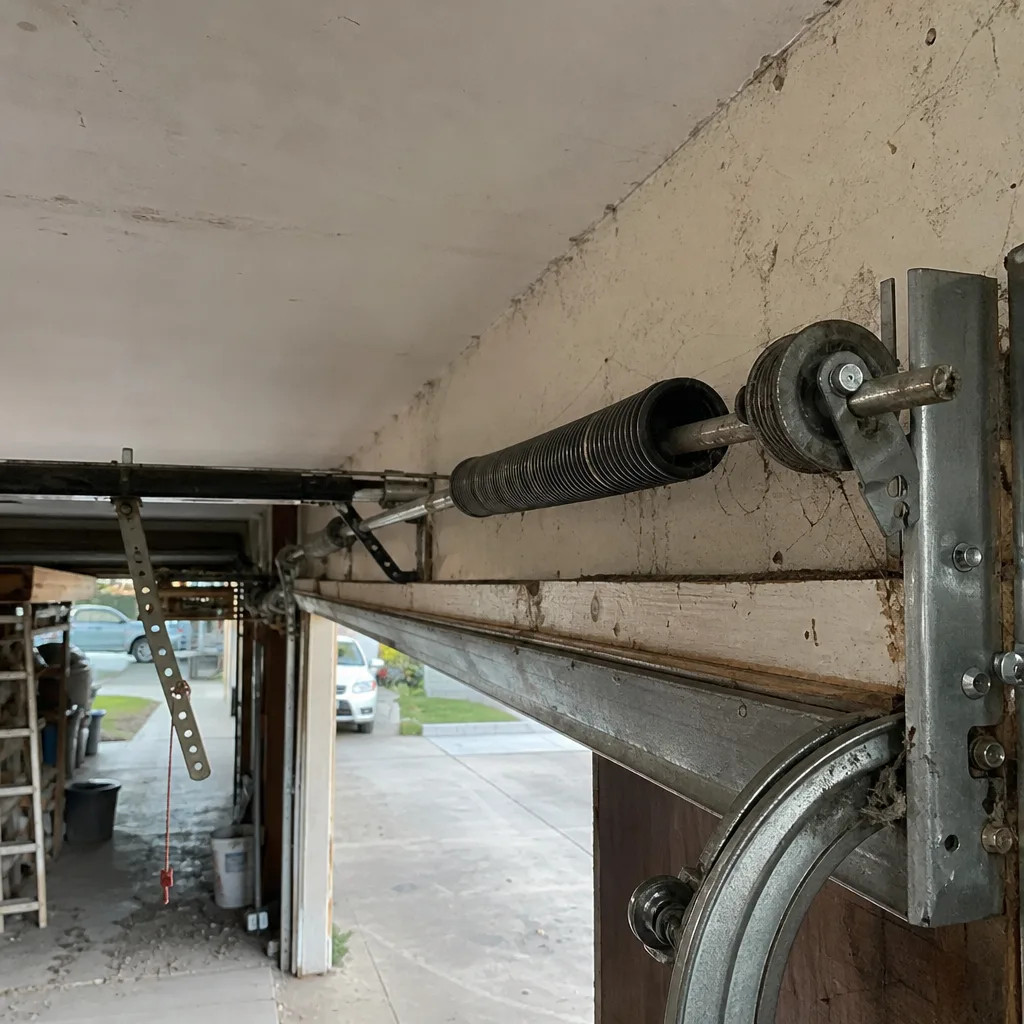 Before
 After
After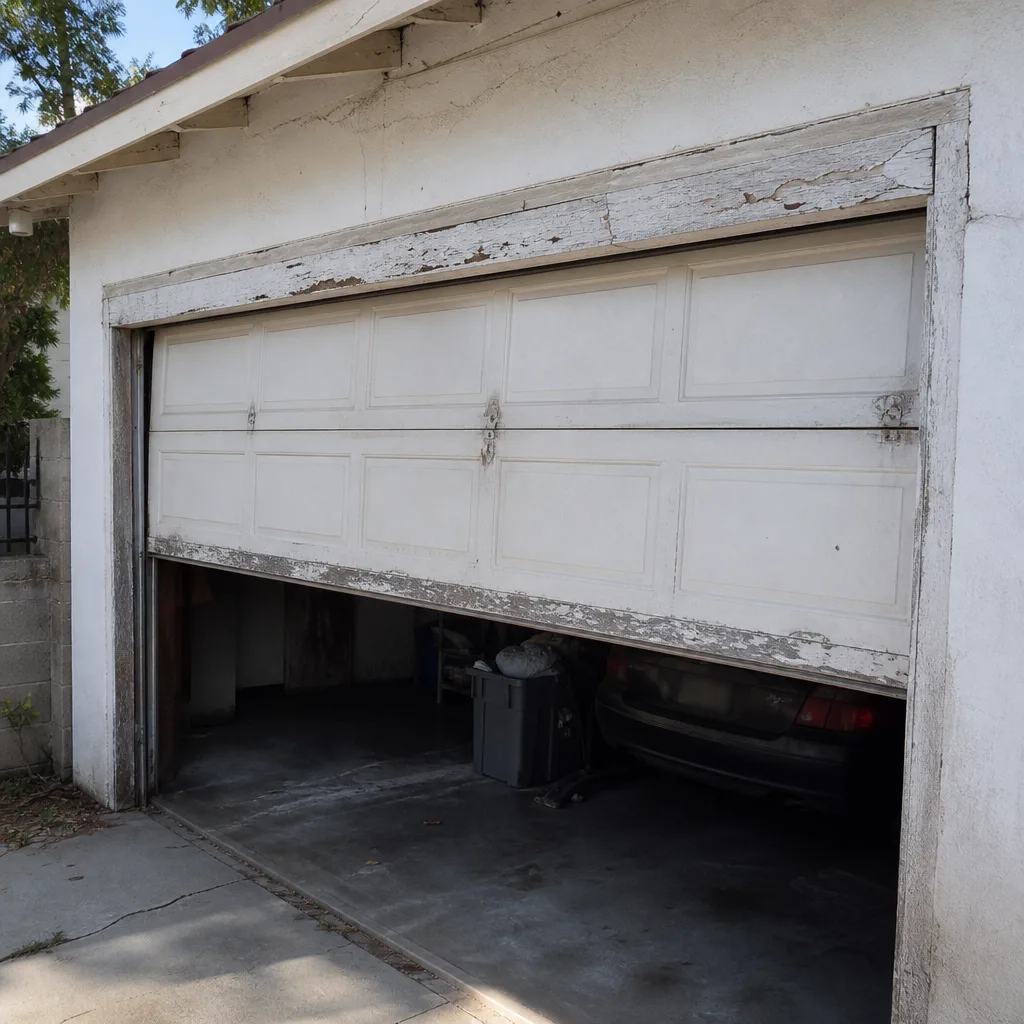 Before
 After
AfterGarage Door Warning Signs: A Van Nuys Homeowner’s Reference Guide
A garage door that reverses unexpectedly on closing gets reported as “the sensor is dirty” and cleaned, but in roughly 30% of cases we see in Van Nuys, it’s a spring tension imbalance that will snap within 60 to 90 days. Cleaning the sensor changes nothing because the sensor was never the problem. This guide and our complete guide to garage doors in Van Nuys sort every warning sign into three tiers of urgency, explain what each symptom actually costs to address now versus later, and cover two heat-specific failures that national guides miss entirely. If you own a home anywhere from Van Nuys to Sherman Oaks, this is the reference to keep bookmarked.
Quick Answer
Garage door warning signs fall into three severity tiers: Stop Using Now (broken torsion spring, frayed cable with three or more broken strands, door off its track), Schedule Within 2 Weeks (worn rollers, slow reversal response, uneven side gaps), and Monitor (minor squeaking, cosmetic weatherseal cracks). A broken spring or frayed cable is a safety hazard that typically costs $180 to $340 to repair immediately and $400 to $900 if ignored until the door fails completely. In Van Nuys, you can reach Servo Garage Doors at Servo Garage Doors Van Nuys home for a written quote before any work starts.
Table of Contents
- The Three Severity Tiers: How to Sort What’s Urgent From What Can Wait
- Stop Using Now: The Three Symptoms That Mean Immediate Danger
- Schedule Within 2 Weeks: Warning Signs That Won’t Kill Anyone Today
- Monitor: Minor Symptoms That Are Easy to Overreact To
- Two Van Nuys-Specific Warning Signs National Guides Miss
- How to Photograph Each Warning Sign So a Technician Can Assess It Remotely
- Why an Unevenly Moving Door Is a Cable or Spring Problem First
- The Dollar Cost of Acting on Each Tier
BeforeAfterThe Three Severity Tiers: How to Sort What’s Urgent From What Can Wait
Most garage door warning sign guides list symptoms without telling you which ones indicate immediate danger versus deferred maintenance. That gap is why homeowners either ignore a snapping cable or panic over a squeaky roller. A cable with three broken strands is a loaded weapon. A roller that chirps on a cold Van Nuys morning is a $12 part that can wait until Saturday. The difference matters, and sorting symptoms by severity is the first skill every homeowner should learn.
Here’s the framework we use on every Garage Door Repair in Van Nuys call. It’s simple enough to remember at 6 a.m. when your door won’t open and you’re already late.
- Tier 1: Stop Using Now. These symptoms mean the door can fail catastrophically with no additional warning. A broken torsion spring under tension, a cable with visible broken strands, or a door that has jumped its track demands immediate action. Do not operate the door. Do not try to “help it” along.
- Tier 2: Schedule Within 2 Weeks. These symptoms indicate wear that will become a Tier 1 problem if ignored for 30 to 90 days. Worn rollers with visible flat spots, a safety reverse that responds slowly, or uneven gaps between door sections get worse with every cycle.
- Tier 3: Monitor. These symptoms are annoying but not dangerous. Minor squeaking, cosmetic weatherseal cracks, or a door that runs slightly slower than it did a decade ago can wait until your next scheduled maintenance visit.
The reasoning is straightforward: Tier 1 symptoms involve components under tension or load that can fail without warning. Torsion springs store enough energy to lift a 150 to 300 pound door dozens of times per day. When that energy releases through a broken cable or worn bracket instead of through the spring’s controlled mechanism, the result is a door that can drop in under a second. A person, a car, or a pet underneath becomes the casualty.
Tier 2 symptoms involve components that fail progressively. You get weeks of warning, not milliseconds. Tier 3 symptoms are about comfort and longevity, not safety.
Stop Using Now: The Three Symptoms That Mean Immediate Danger
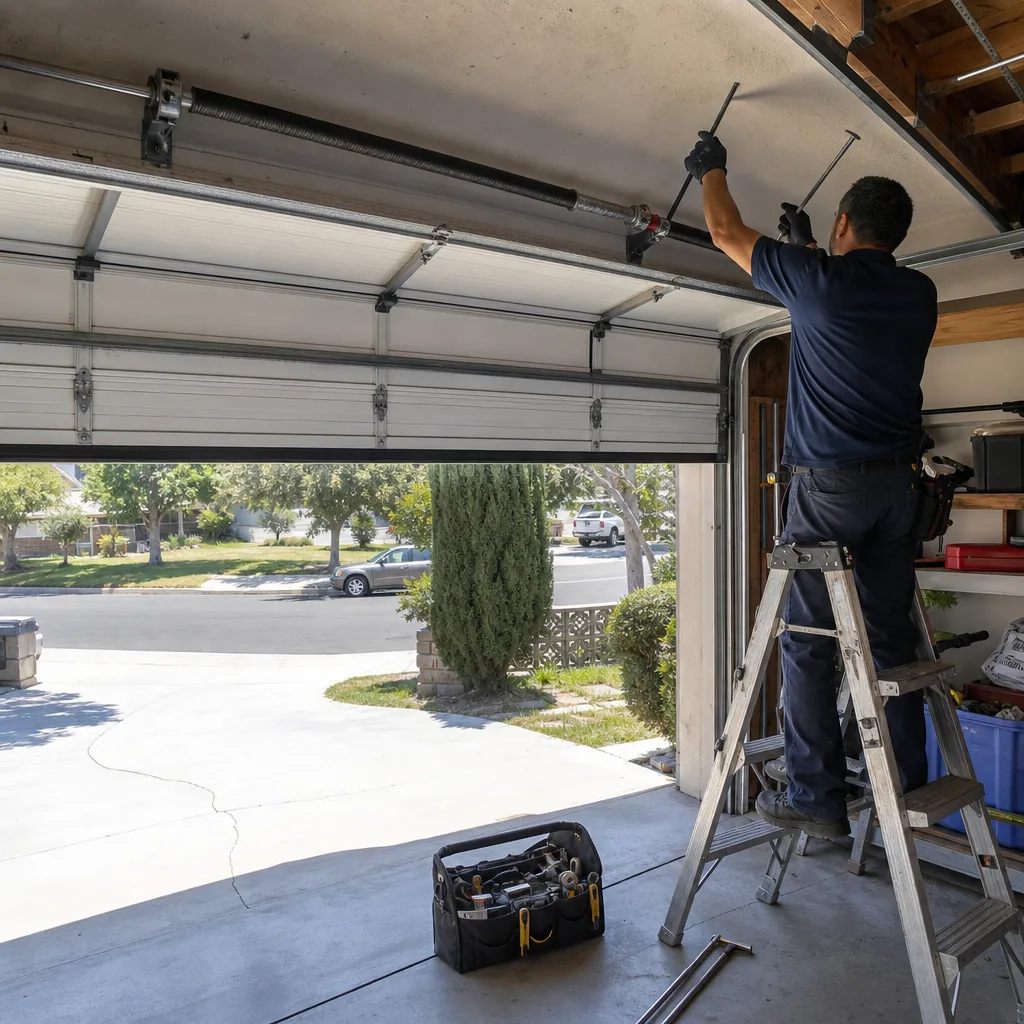
These are the symptoms that justify pulling the release cord, locking the door in place if possible, and calling for same-day service. We’ll name the part, explain what it does in plain language, and tell you what you’ll see and hear.
1. A Broken Torsion Spring
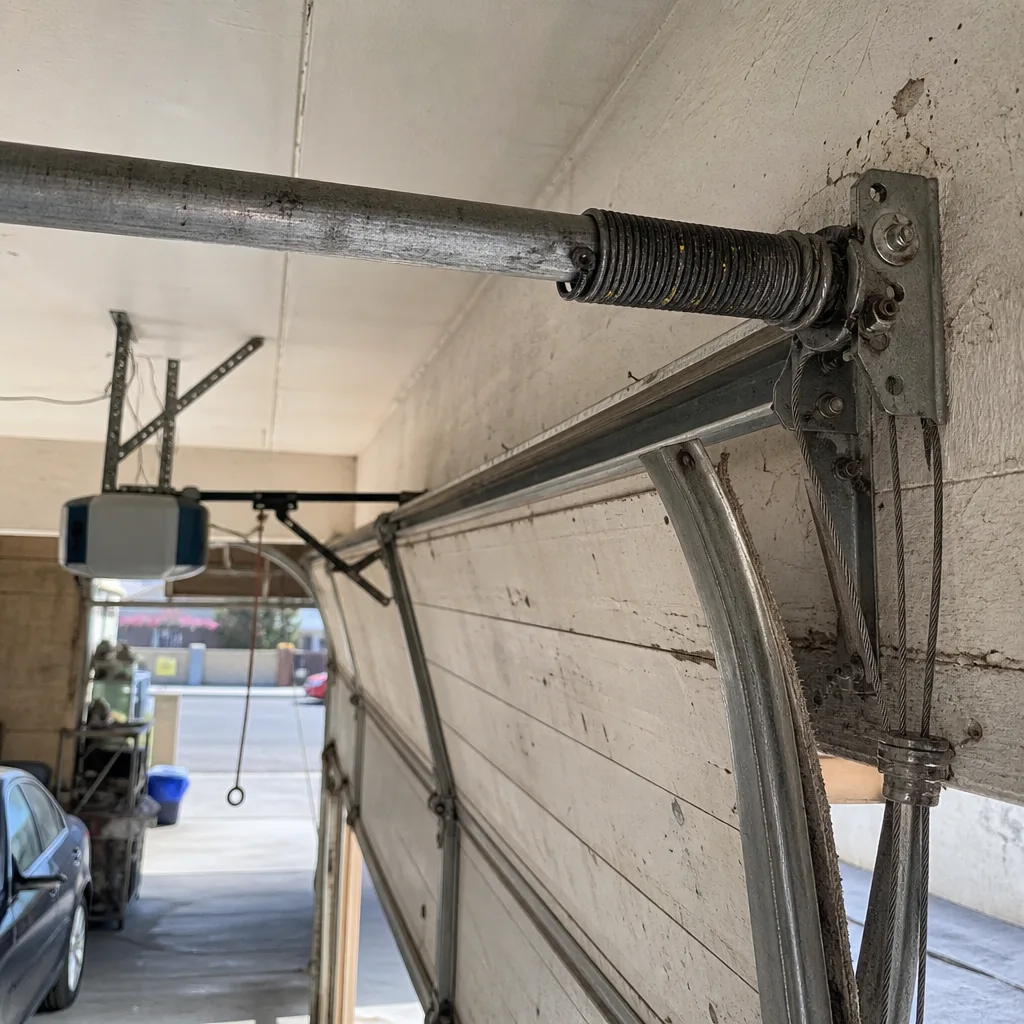
The torsion spring is the tightly wound coil mounted horizontally above the door opening. It counterbalances the door’s weight so a small opener motor can lift hundreds of pounds. When it breaks, you’ll hear a sound like a gunshot from inside the garage. The door will refuse to lift more than a few inches, or it will lift only with extreme manual effort and then hold only because the opener’s brake or a secondary spring catches it.
A broken spring is not a partial-function situation. The door’s entire balance system has failed. If you have a two-spring system and only one snapped, the remaining spring is now bearing double its rated load and will fail sooner. Operating the door in this condition risks a sudden drop, damage to the door panels, and injury.
- What you’ll notice: A loud bang, a visible gap in the spring coil, the door feeling extremely heavy, the opener straining or refusing to lift.
- Action: Stop using the door. Call for repair. Expect a replacement cost of $180 to $340 in Van Nuys for a standard residential torsion spring, including installation.
- Why immediate: The remaining components are now under stress they were not designed to bear. A cable, bracket, or hinge failure is next, and that failure can be sudden and dangerous.
One note specific to Van Nuys: temperature swings between the cool San Fernando Valley nights and 100-plus-degree summer days cause metal fatigue faster than in coastal climates. We replace more springs in Van Nuys per capita than in any other zip code we serve.
2. A Frayed Cable With Three or More Broken Strands
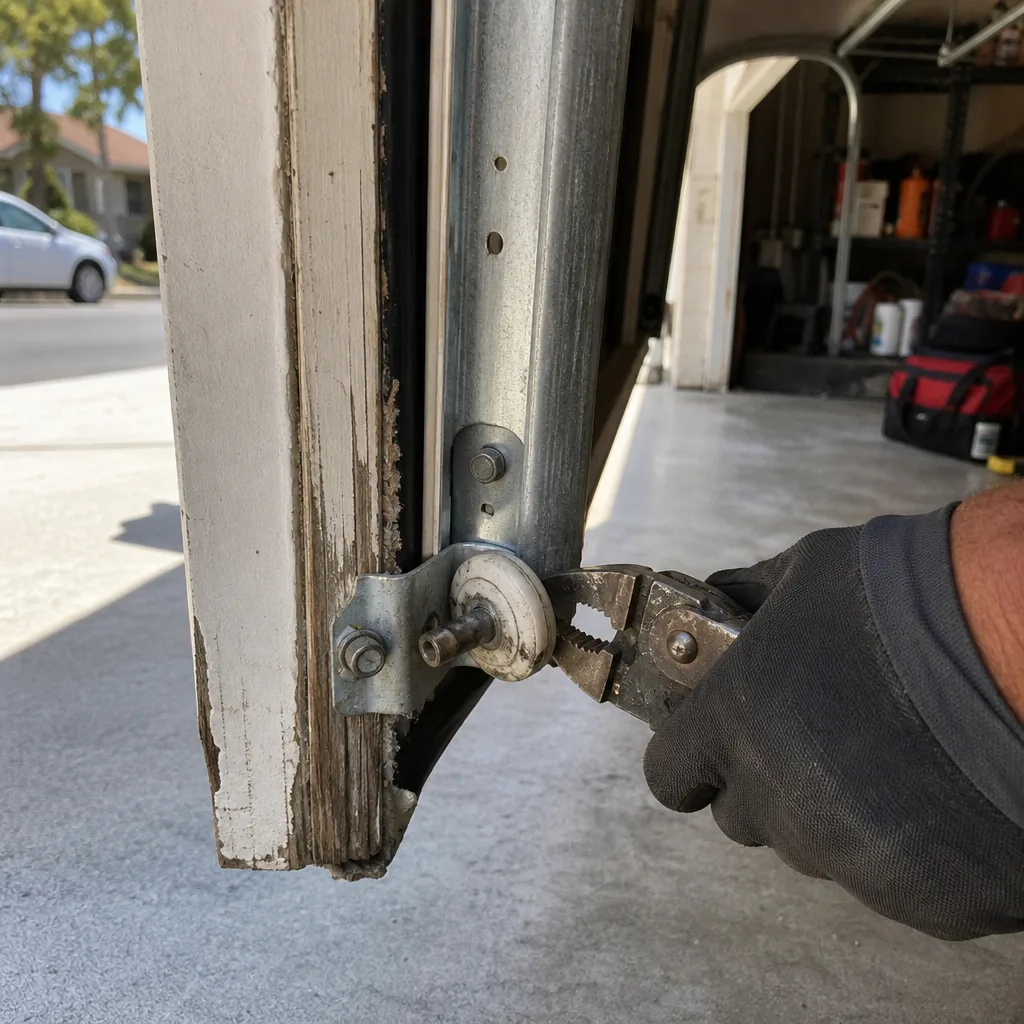
Lift cables run along both sides of the door and transfer the spring’s tension to the bottom brackets. Each cable is made of dozens of thin steel wires twisted together. When individual strands begin snapping, the cable loses its rated capacity. Three broken strands is the threshold where we tell customers to stop using the door.
The cable is under tension equal to roughly half the spring’s stored energy. When a cable with significant fraying finally parts, that energy releases instantaneously. The door drops on one side, the other side twists, and the remaining cable often tears through the bottom bracket. The door can fall completely off its track.
- What you’ll notice: Small steel “hairs” protruding from the cable, a kink or flat spot in the cable, or visible rust where the cable meets the bottom bracket.
- Action: Stop using the door. Do not attempt to clip or trim the frayed strands. Call for replacement. Expect $150 to $250 per cable in Van Nuys, with both cables typically replaced as a pair for $250 to $400.
- Why immediate: A frayed cable under tension has no predictable failure timeline. It can hold for three more months or part in the next minute.
We photograph every frayed cable we find before quoting replacement. Clause 4 of The Haven Standard is why the technician photographs the failed part before quoting a replacement, and it applies here without exception. You’ll see the broken strands yourself, in the photo, before you agree to anything.
3. A Door That Has Jumped Its Track
The door rides on a set of metal tracks on both sides, guided by rollers. When a roller breaks, a track gets bent by impact, or a cable releases unexpectedly, the door can partially leave the track. The door will appear visibly crooked, may bind partway through its travel, and will make grinding or scraping sounds.
- What you’ll notice: The door is visibly askew. One side may be higher than the other. You may see a gap between the roller and the track.
- Action: Stop using the door immediately. Do not attempt to force it back onto the track by hand. Call for professional repair.
- Why immediate: A door partially off its track is unsupported on one side. The entire weight now rests on a single track and a single cable, neither of which is designed for that load. Collapse is imminent.
Expect a track realignment to cost $150 to $300 in Van Nuys if the track itself is undamaged. If the track needs replacement or the door sustained panel damage, budget $350 to $700. We quote a flat, written price and a written scope before any work starts, always, on every job, per Clause 1 of The Haven Standard.
Schedule Within 2 Weeks: Warning Signs That Won’t Kill Anyone Today
These symptoms are progressive. They won’t cause a catastrophic failure in the next hour, but each week of inaction brings you closer to a Tier 1 emergency. The smart play is to address them on your schedule, not the door’s.
Worn Rollers With Visible Flat Spots
Rollers are the small wheels attached to the door’s hinges that ride inside the tracks. Most residential doors have 10 to 12 rollers, typically nylon, steel, or nylon-coated steel. Over time, bearings wear out and the roller develops flat spots or stops spinning entirely. A roller that slides instead of rolls creates friction that loads the opener motor and the spring system beyond their design spec.
- What you’ll notice: A rough or chattering feel during operation, visible flat spots on roller wheels, excessive wobble, or rollers that are no longer round.
- Action: Schedule a Garage Door Installation in Van Nuys ticket within two weeks if you can’t DIY the roller swap safely. Expect $10 to $25 per roller for professional replacement, or $120 to $250 for a full set with labor.
- Why the deadline: Worn rollers accelerate track wear and force the door to work harder on every cycle. A few weeks of grinding chews through the track’s wear surface, turning a $200 roller job into a $600 track replacement.
Slow Safety Reverse Response
Every automatic opener manufactured after 1993 is required to have a safety reverse mechanism. When the door encounters resistance while closing, it should stop and reverse immediately. If you test it with a roll of paper towels or a 2×4 laid flat on the ground and the door hesitates, pushes down for a second, or doesn’t reverse at all, the opener’s force setting or its sensors need attention.
- What you’ll notice: The door continues downward for a half second or more after hitting an obstacle, or it reverses with a visible delay.
- Action: You can test the reverse yourself with a solid object on the ground. If the response is slow or absent, schedule an opener service call. Expect $90 to $180 for sensor realignment and force adjustment on a LiftMaster or Chamberlain unit.
- Why the deadline: A slow reverse response is a child or pet safety issue. The difference between a working reverse and a slow response is several hundred pounds of downward force applied for a split second longer than it should be.
Uneven Gaps Between Door Sections
Stand inside the garage with the door closed and look at the seams where the door panels meet. They should be tight and even. If you see daylight through a seam, or the gap is wider on one side, the door’s sections are separating. This usually means hinges are wearing, or the door has shifted out of square due to a spring or cable imbalance.
- What you’ll notice: Light visible through closed door seams, uneven spacing between panels, or a door that looks slightly crooked when closed.
- Action: Schedule a diagnostic visit within two weeks. This is often a hinge or bracket issue that runs $100 to $250 to correct, but if left alone it becomes a panel crack that requires a $300 to $500 section replacement.
- Why the deadline: Gaps indicate structural stress. The door is flexing in ways the panel joints were not designed to flex. Cracks form quickly once the flexing reaches the panel’s rigid aluminum or steel skin.
Monitor: Minor Symptoms That Are Easy to Overreact To
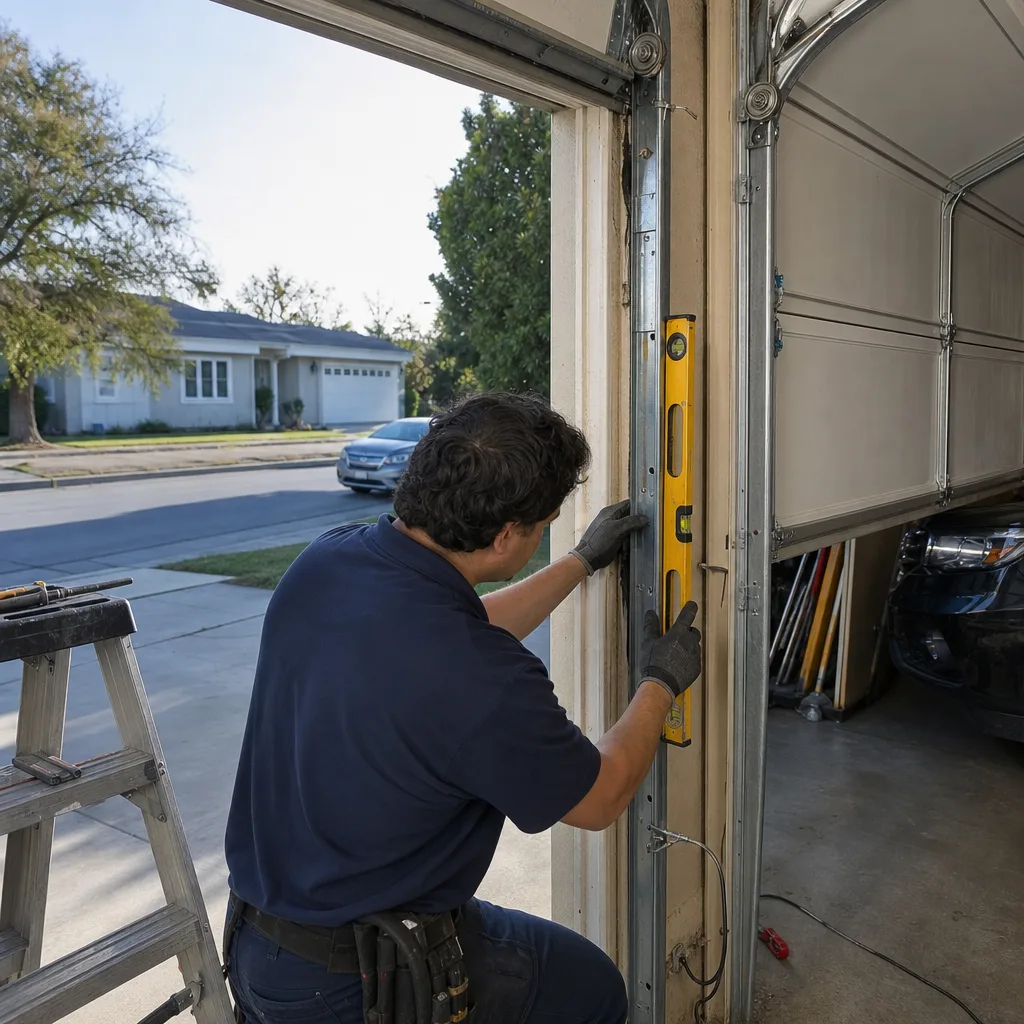
These symptoms set off alarm bells when they shouldn’t. They’re worth noting and worth fixing, but they don’t require a service call this week. Here’s what to watch and what it means when you eventually get around to it.
Minor Squeaking or Squealing During Operation
A squeak usually means dry metal-on-metal contact. It comes from hinges, springs, or rollers that need lubrication. It does not mean anything is about to fail. The fix is a $6 can of white lithium grease or silicone spray applied to the hinges and rollers once or twice a year, which is the appropriate maintenance schedule in Van Nuys’s dry, dusty climate-see our seasonal garage door care guide for a full year-round schedule. Dust collects faster here than in humid coastal air, and clean lubrication surfaces matter.
Cosmetic Weatherseal Cracks
The rubber strip at the bottom of your door and the vinyl gaskets around the sides keep dust, water, and pests out. Fine cracks that don’t go all the way through the material are cosmetic. But when a gap opens up that lets daylight or water through, it’s time to replace the seal. A bottom seal replacement costs $60 to $120 installed in Van Nuys. Side seals run $40 to $80 per side.
A Door That Runs Slightly Slower Than It Did Five Years Ago
Openers lose a bit of speed as they age, and springs lose a bit of tension each year. If the door still moves at a steady pace and opens and closes fully every time, this is normal aging, not a warning sign. Just be aware of the trend. When it starts changing week to week, that’s when the spring is telling you something.
Two Van Nuys-Specific Warning Signs National Guides Miss
National guide pages are written for a generic American home with four seasons. Van Nuys has a different climate reality: extreme summer heat, low humidity, and intense UV exposure that attacks garage door components in specific ways. Two warning signs show up repeatedly in our Van Nuys service calls that you won’t see mentioned on most national guides.
1. Finish Bubbling on Steel Doors
Steel garage doors in Van Nuys take a beating from the sun. The dark metal absorbs heat, and on a 105-degree day the surface of a west-facing door can reach 140 degrees or higher. That heat, combined with UV radiation, attacks the paint or powder coat finish. The first sign is small bubbles or blisters in the finish, usually on the panels that face the afternoon sun.
What the bubbling tells you is not just that the finish is failing. It indicates the steel panel is expanding and contracting at a different rate than the aluminum frame or the adhesive layer beneath. That differential movement eventually leads to delamination, where the steel skin separates from the door’s internal structure. A delaminated panel loses its rigidity and can bend or tear out of its hinge mounts.
- What you’ll notice: Bubbles, blisters, or ripples in the door’s finish, most commonly on the lower panels and the side that gets direct afternoon sun.
- Action: Monitor if the bubbling is purely cosmetic and localized. Schedule a diagnostic if you see ripples spreading across multiple panels or cracking along the panel edges.
- Cost to address: Refinishing a panel runs $150 to $300. Replacing a delaminated panel runs $250 to $450 per panel. Replacing the entire door with a heat-reflective finish starts around $1,200 to $2,500 depending on size and insulation, which is a conversation for a Garage Door Installation in Van Nuys appointment.
2. Operator Overheating Manifesting as Mid-Cycle Stops
Garage door openers generate heat when they run, and they rely on passive cooling to shed it. In a hot Van Nuys garage, the ambient temperature is already 90 to 110 degrees before the motor does any work. Older openers, or openers with inadequate ventilation, can hit their thermal cutoff switch mid-cycle. The door stops halfway through opening or closing, then refuses to respond for 5 to 15 minutes until the motor cools down.
This is not a sensor issue and not a spring issue. It’s a heat management issue, and it happens far more on hot afternoons than at any other time. Genie and Chamberlain openers both have thermal protection circuits that trip around 150 to 170 degrees at the motor housing. In a poorly ventilated garage, that threshold is reachable on a 100-degree day.
- What you’ll notice: The door stops mid-cycle, usually in the afternoon, and won’t respond again for several minutes. The opener housing feels hot to the touch.
- Action: Improve garage ventilation as a first step. If the problem persists, the opener’s motor may be worn and drawing more current than it should. Expect a replacement opener to cost $350 to $650 installed in Van Nuys for a belt-drive LiftMaster or Chamberlain unit.
- Why Van Nuys-specific: Coastal homes rarely see this failure because their garages stay 15 to 20 degrees cooler. Inland valley heat pushes opener temperatures into the thermal protection zone on a regular basis each summer.
How to Photograph Each Warning Sign So a Technician Can Assess It Remotely
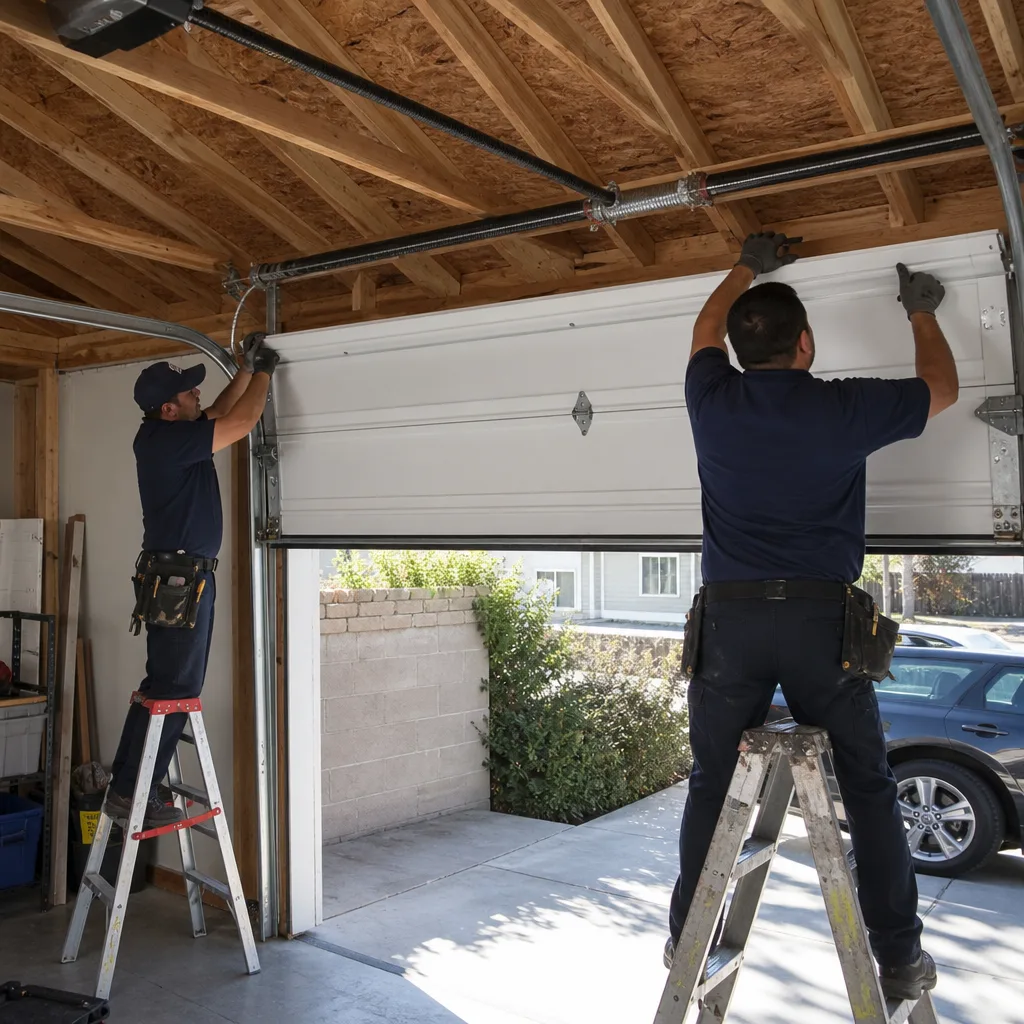
We built our business on photographic evidence. Clause 4 of The Haven Standard requires our technicians to photograph the failed component before quoting a replacement, and we ask the same of homeowners who want a remote assessment before scheduling a visit. Good photos save time and often eliminate a trip charge. Here’s how to photograph each common warning sign correctly.
- Torsion spring: Stand on a ladder at eye level with the spring, about 3 to 4 feet away. Use your phone’s flash even in daylight, which brings out the break point and the coil’s surface condition. Photograph the entire spring from end to end, then take a close-up of any visible gap or break.
- Lift cable: Kneel at the base of the door and photograph the cable where it attaches to the bottom bracket. Use a flashlight aimed at the cable from a 45-degree angle so frayed strands cast shadows. Take one shot of the bracket, one of the cable’s full visible length, and one macro shot of the frayed area.
- Rollers: With the door closed, photograph the rollers from inside the garage at track level. Stand directly perpendicular to the track, not at an angle. A side-angle shot distorts whether the roller is actually round. Take individual shots of any roller that appears worn.
- Bottom brackets: Photograph each bottom bracket from below at a 45-degree upward angle, with lighting from the side to show whether the bracket is bent or pulling away from the door.
After you have the photos, you can send them to us before a technician drives out. If you have a written estimate from another company, bring the paperwork and we’ll provide a Free Second Opinion on any written estimate from another company, no coupon or code required.
Why an Unevenly Moving Door Is a Cable or Spring Problem First
When a garage door rises unevenly or looks crooked during operation, most homeowners assume the track is bent or the sensor is misaligned. In our experience across thousands of Van Nuys service calls, that assumption is backwards. Here’s the diagnostic sequence we follow, and why it matters.
The correct order: cable first, spring second, track third, sensor last.
Here’s the reasoning. Your door’s balance comes from the torsion spring system, which transfers force through the lift cables to the bottom brackets on each side of the door. When one cable stretches, frays, or begins slipping, that side of the door receives less lifting force than the other. The door rises unevenly. When one spring in a two-spring system weakens faster than the other, the same imbalance occurs.
The track is a passive guide. It holds the rollers in place, but it does not lift or balance anything. A bent track causes binding, not uneven lifting. Binding feels like a door that sticks or jams at a specific point in its travel. An unevenly moving door that rises smoothly but crookedly is almost always a cable or spring issue.
Sensors are the last place to look because sensors only affect the door’s operation near the floor, where the photo eye beam runs. Sensors can stop the door from closing or cause it to reverse, but they cannot lift one side of the door higher than the other. If your door rises crookedly and then closes fine, sensor misalignment is not the problem.
We see this diagnostic sequence get reversed constantly. Homeowners call about a “bent track” when the real problem is a stretched cable. The cable gets replaced, the door levels out, and the track was never the issue. Getting the sequence right means you don’t pay for a track adjustment you don’t need.
The Dollar Cost of Acting on Each Tier
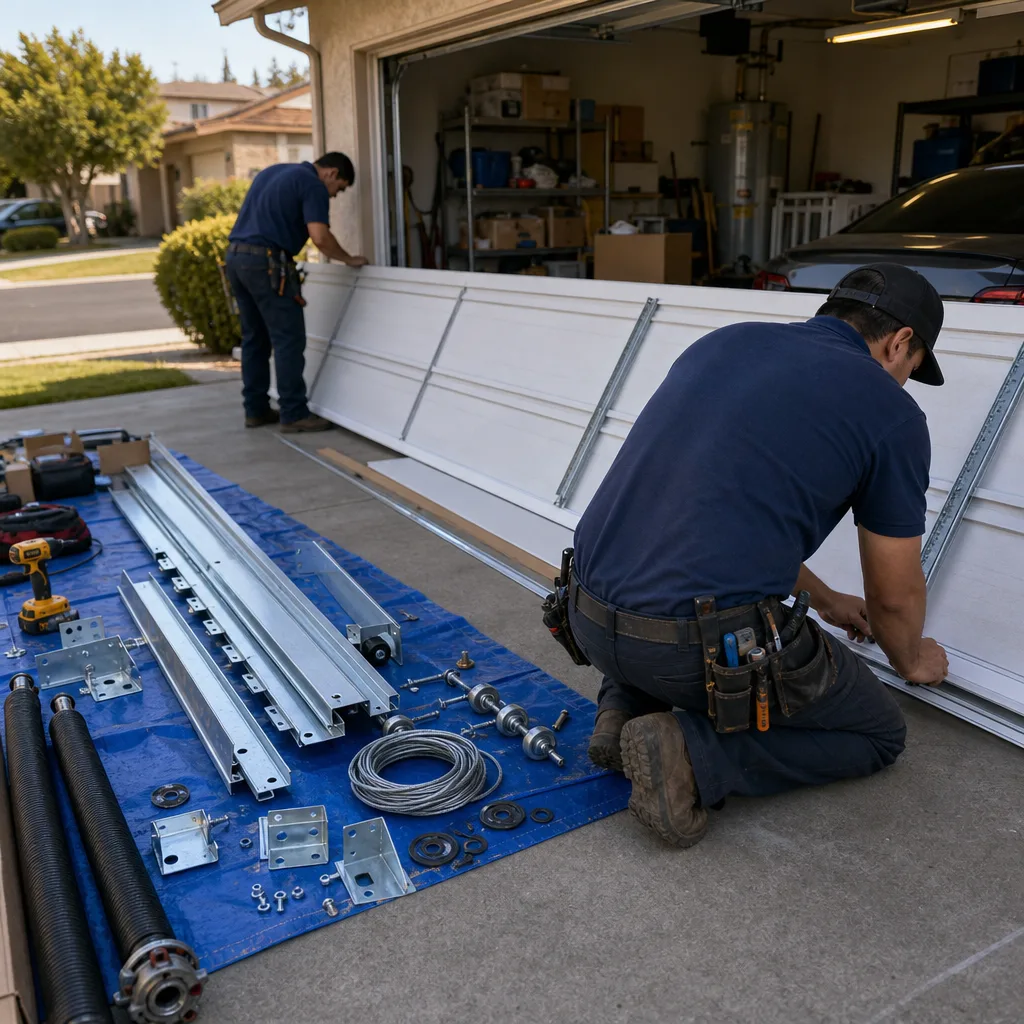
Here’s what each symptom costs to address immediately versus after it has failed. These are Van Nuys market prices as of 2025, reflecting what we quote and what we see on competitor estimates. Prices are flat, written, and agreed before work starts, per Clause 1 of The Haven Standard.
- Broken torsion spring: $180 to $340 immediately. If ignored until the door drops, add $200 to $500 for panel damage, $100 to $250 for cable replacement, and $50 to $150 for track realignment. Total failure repair: $530 to $1,240.
- Frayed cable (3+ strands): $150 to $250 per cable immediately. If the cable snaps under a vehicle, add $300 to $800 for bottom bracket replacement and panel repair, plus the risk of damage to the vehicle itself.
- Worn rollers: $120 to $250 for a full set immediately. If ignored until rollers disintegrate, add $150 to $400 for track scoring repair and potential roller stem replacement.
- Slow safety reverse: $90 to $180 for adjustment immediately. If ignored and the door crushes a child, pet, or object, the financial cost is irrelevant. This is the one repair where the cost of ignoring it cannot be measured in dollars.
- Finish bubbling (Van Nuys heat): $150 to $300 to refinish a panel before delamination. After delamination, $250 to $450 per panel or $1,200 to $2,500 for a new door with a heat-reflective finish.
- Operator overheating: $0 to improve ventilation. If the motor has already heat-damaged its windings, $350 to $650 for a replacement opener with installation.
We handle Garage Door Opener Repair & Installation in Van Nuys across all major brands including LiftMaster, Chamberlain, Genie, and Clopay. The written estimate you receive includes the specific part number, the labor scope, and the total price, with no surprises added after the fact.
Common Mistakes to Avoid
- Assuming a loud bang was something falling in the garage. A broken torsion spring sounds like a gunshot. If you hear a loud bang from the garage and the door won’t open, the spring is almost certainly broken. Don’t assume a shelf fell.
- Lubricating a broken roller. If a roller has a flat spot or has stopped spinning, lubrication will not make it round again. You’re buying a few days of reduced noise at the cost of accelerated track wear.
- Spraying WD-40 on torsion springs. WD-40 is a solvent and a light lubricant, not a spring lubricant. White lithium grease or silicone spray is correct. WD-40 will strip existing grease and leave the spring drier than before.
- Ignoring a slow safety reverse because the door “still works.” The reverse mechanism is a safety system. If it’s slow or nonresponsive, the door is not safe to operate around people or pets. This is the one repair you should prioritize above all cosmetic issues.
- Forcing a door back onto its track by hand. The door weighs 150 to 300 pounds. If it has partially left the track, the remaining cable is holding more load than it’s rated for. Forcing the door shifts weight unpredictably and can cause the remaining cable to snap.
- Ignoring Van Nuys heat damage because “it’s just cosmetic.” Bubbling finish is the first visible sign of panel delamination. By the time the panel actually separates, the repair is twice as expensive.
When to Call a Professional
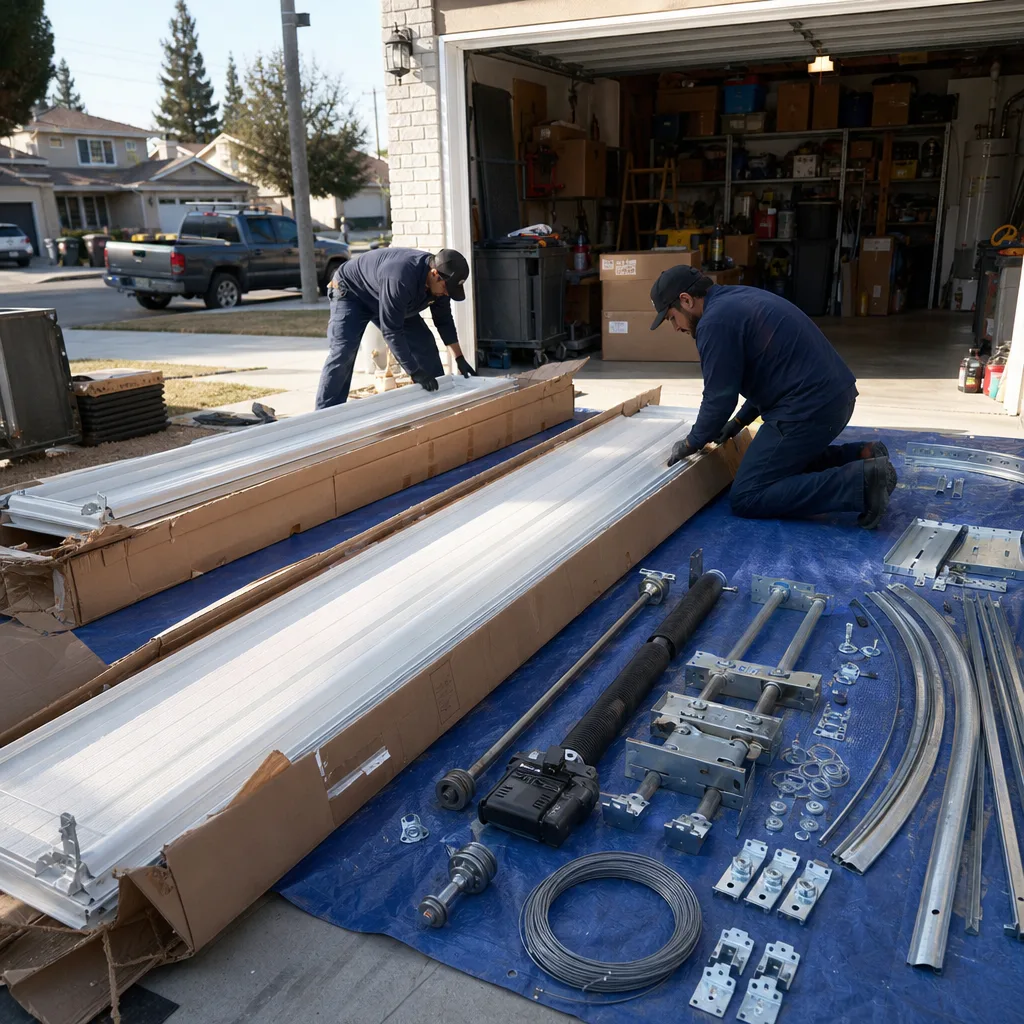
Call a professional the moment you identify any Tier 1 symptom: a broken spring, a frayed cable with three or more strands, or a door off its track. These are not DIY situations and they are not wait-and-see situations. For Tier 2 symptoms, call when you can schedule within a two-week window. For Tier 3 symptoms, calling once a year for a maintenance check is sufficient. Servo Garage Doors Van Nuys offers free estimates in Van Nuys. Call (213) 418-2520 for a written quote before any work starts. Calls are answered by a live person, 24/7, including emergency garage door calls, with a named technician and an on-the-way text, not a callback window.
Frequently Asked Questions
Garage door spring repair in Van Nuys typically costs $180 to $340 for a standard residential torsion spring, including the spring and installation labor. The price is flat, written, and agreed before any work starts. Call (213) 418-2520 for an exact quote. Estimates are free.
Yes, in most cases we can replace a broken spring the same day in Van Nuys. Our phone is answered by a live person 24/7, including holidays, and emergency calls receive a named technician and an on-the-way text. Call (213) 418-2520 and we’ll tell you when a technician can arrive.
No. The flat, written price we quote covers the complete repair scope. If the technician finds additional issues, those are quoted separately and require your approval before any additional work. Clause 1 of The Haven Standard means the price you agree to is the price you pay.
Most common parts are on the truck on every service call: torsion springs in standard sizes, lift cables, rollers, hinges, brackets, and weatherseals. For unusual door models or non-standard sizes, parts may require a same-day or next-day pickup. In Van Nuys, most repairs are completed in a single visit.
A loud bang when opening almost always means a broken torsion spring. The spring breaks under tension, and the released energy creates the sound. Stop using the door and call for immediate repair. Expect $180 to $340 in Van Nuys for a standard replacement.
Standard torsion springs are rated for 10,000 cycles, which translates to roughly 7 to 10 years in a typical Van Nuys home that cycles the door three to four times per day. Heat and temperature fluctuation can reduce that lifespan. If your springs are older than seven years, have them inspected during your annual maintenance visit.
The Bottom Line
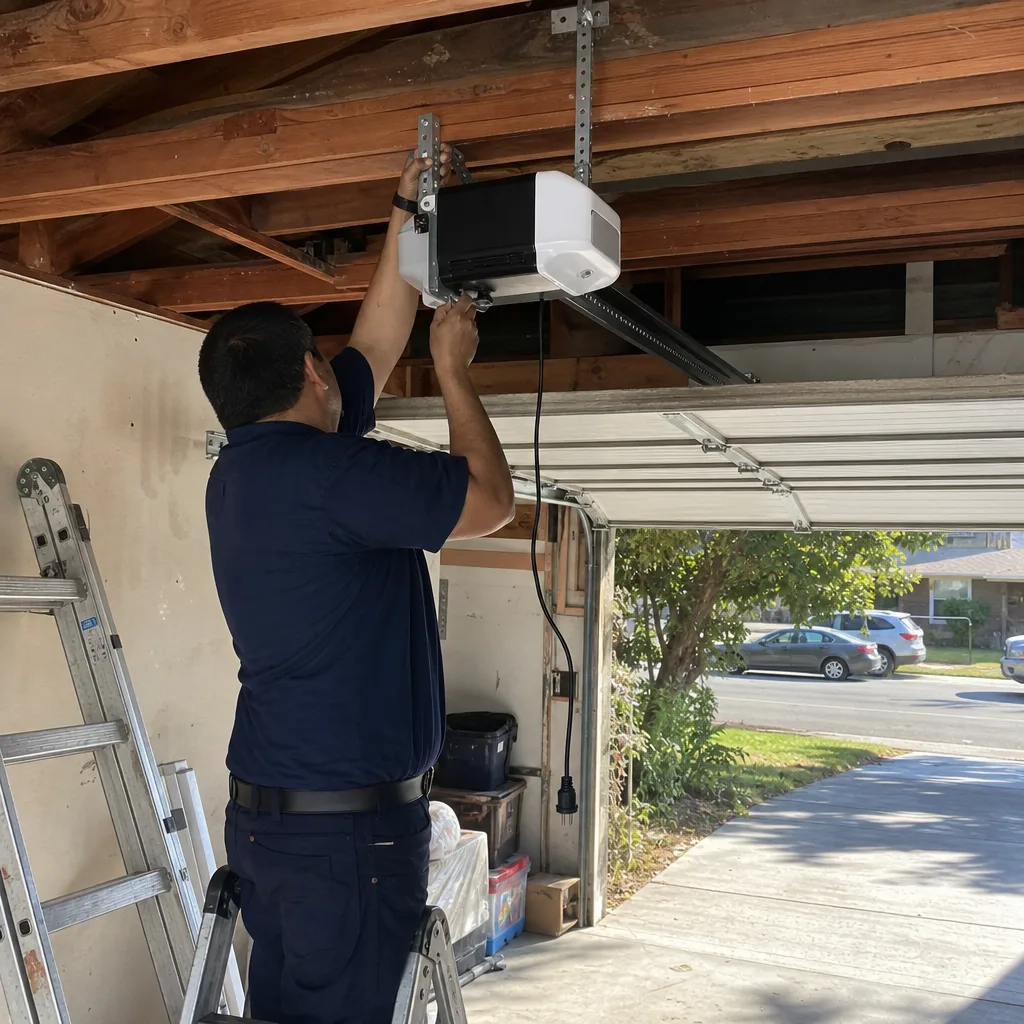
Garage door warning signs sorted into three tiers give you a decision framework instead of a list of scary symptoms. A broken spring, frayed cable, or off-track door means stop using the door and call immediately. Worn rollers, slow safety reverse, or uneven gaps mean schedule within two weeks. Squeaking and cosmetic cracks mean monitor and maintain. In Van Nuys, add two heat-specific symptoms to your checklist: finish bubbling indicating panel delamination and mid-cycle stops indicating operator overheating. Photograph what you find, get a written price before work starts, and browse our more guides & resources to stay ahead of problems. And when the door talks, listen.
Written by Marcus Deller, Owner at Servo Garage Doors Van Nuys, serving Van Nuys since 2015.